It would be easy to claim that most books written with the intention of creating change fall into nonfiction genres. However, every fiction book has the potential to move readers to change—if written specifically with that goal in mind. Indeed, novels can inspire and motivate personal, spiritual, organizational, or world change.
You might argue that reading any novel changes the reader. After all, the protagonist in every novel experiences transformation, and that change can inspire and motivate readers to seek a similar transformation in their lives. However, this type of impact becomes more likely when the novelist intentionally crafts the book to inspire change.
Here are five ways novelists can write for change:
1. Use the Hero’s Journey
Novelists are well acquainted with the Hero’s Journey, a universal story structure identified by Joseph Campbell. Those novelists who want to write for change need to pay particular attention to this familiar narrative template.
Recall that stories told using this story structure include a hero who goes on an adventure, meets a guide, learns a lesson, wins a victory, and returns home transformed. When you write for change, craft your manuscript so readers can easily put themselves in the protagonist’s shoes. When they relate to your protagonist on a deep, emotional level, they become the hero. They go on the same adventure, meet a guide, learn a lesson, and finish the book transformed.
If you write in such a way that readers experience the story rather than just read it, the novel becomes the reader’s guide to change. Readers become the protagonist while reading the book, leading them to believe they can change in the same way as the main character.
2. Understand How People Change
Bolster your writing-for-change skills by studying how people change. This will help you create believable characters and move your readers to take new action.
Specifically, study the art of influence or persuasion. Also, learn about personal growth techniques. Educate yourself on successful sales tactics and habit formation strategies. Then use some of what you’ve discovered as you write your manuscript to influence both protagonist and reader.
3. Focus on Adding Value
A book’s benefits equate to its value. Readers don’t care what your book is about as much as how reading it benefits them.
All novels can—and usually do—add value. However, if you level up the benefit of your book, your readers are more likely to pick it up, read it, and feel inspired or motivated to take new action.
Just read the back cover of any novel, and you will discover the benefit of reading the book. The description or synopsis makes the benefits apparent. For instance, Allen Levi’s Theo of Golden is described as “a story of giving and receiving, of seeing and being seen.” Most people want to experience these things—they are desirable and beneficial. The description goes on to say the story is about “the power of creative generosity, the importance of wonder to a purposeful life, and the invisible threads of kindness that bind us to one another.”
If a reader doesn’t currently have the benefit your book offers, they will want to discover how to get it. Your story can inspire and motivate them to take the action to create what they desire—even if it is not a personal benefit but a more global one.
4. Use Persuasive Language Patterns
Long before Neuro-Linguistic Programming (NLP) existed as a formal model, novelists used persuasive language. NLP simply named and systematized techniques that great writers were using intuitively, such as sensory language, pacing and leading, embedded commands, identity framing, metaphor, and emotional anchoring.
Notable novelists’ work clearly reflects what we’d now call NLP-style persuasive language. For example:
- William Shakespeare used embedded commands, rhythm-based persuasion, metaphor, identity shifts, and commands embedded in advice.
- George Orwell used techniques such as belief framing, reframing reality, meta-persuasion, and metaphor.
- Aldous Huxley used conditioning, suggestion, trance-like repetition, and hypnotic persuasion via slogans and repetition.
- Paulo Coelho uses affirmations, metaphors, presupposed meaning, and installed beliefs.
- Dan Brown uses pacing, cliffhanger-based attention loops, belief-provoking language, certainty framing, and keeps readers in a heightened state of curiosity and urgency.
Learn the basics of NLP, and you will better understand how the brain processes the words we use and how that can impact readers’ past, present, and future. With a little knowledge, you can begin using NLP language patterns in your manuscripts and move your readers toward change.
5. Create Contrast for Your Reader
As you tell your protagonist’s story, keep in mind you want both the main characters and the reader to see the contrast between their current circumstances and desired future. Remind your reader, “You are here but want to be there,” or “The world is this way, but you want it to be that way.”
As your protagonist makes decisions, show readers the choices, opportunities, and possibilities available to them. Raise their ambitions for a better future but also ask them to see the deficits of the present.
Novelists Can Write for Change
A host of readers enjoy novels for both escape and meaning and nonfiction for growth and guidance. So, give them all of this in the form of a powerful, transformative novel.
As a novelist, you can write a story that provides escape, meaning, growth, and guidance. Compose novels that have a high likelihood of inspiring and motivating readers to take actions that make a difference in their lives as well as in their close circles, communities, organizations, and the world.
About the Author
 Nina Amir, the Inspiration to Creation Coach, is an Amazon bestselling hybrid author. She supports writers on the journey to successful authorship as an Author Coach, nonfiction developmental editor, Transformational Coach, and Certified High Performance Coach (CHPC®)—the only one working with writers.
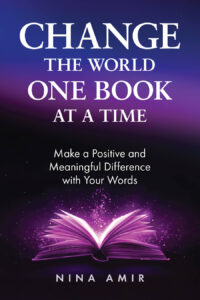
Nina’s most recent book, Change the World One Book at a Time: Make a Positive and Meaningful Difference with Your Words, was released on January 6, 2026, by Books that Save Lives. Previously, she wrote three traditionally published books for aspiring authors—How to Blog a Book, The Author Training Manual, and Creative Visualization for Writers. Additionally, she has self-published a host of books and ebooks, including the Write Nonfiction NOW! series of guides. She has had 19 books on the Amazon Top 100 List and as many as six books on the Authorship bestseller list at the same time.
Nina also coordinates the SFWC’s Personal Growth for Writers track and the Writing for Change Summit. She also offers a conference scholarship for nonfiction writers writing for change.
Find her book on Nina’s site for reader bonuses or at the following retailers:
Nina Amir shares 5 powerful techniques for crafting transformational fiction that moves readers to action: Share on X
Thanks for this inspiring post, Nina. I especially love the ideas of adding value and creating contrast. Happy 2026 to you. :)
Thank YOU! I'm honored to be a guest…after so long. And I trust your readers will find the post useful.
Wish I'd had that book when I first started writing! I do lean heavily on the hero's journey trope though.
Well, you can have it now! :) I hope you'll write for change.
I really like the idea of writing for change. I'll admit it's not something I'd thought specifically about, although I've read many books that do support change. Thank you for sharing your ideas.
You are welcome, Margot. Well…now you can think about writing for change! And I hope you will.
The hero's journey trope is one I've used when writing fantasies. Thanks for your other tips on writing fiction to encourage change.
You are so welcome! I hope this post inspires many novelists to effectively write for change.
People skill books are a great way to learn how real people function which can help with writing.
Indeed. You have to understand the human brain and how it works. So interesting…
I had never actually heard of NLP language patterns, and that says a lot because I'm constantly studying language, psychology, and influencial patterns. Hm. Might have to diver deeper into that one. Looking forward to it!
Yes, it's very interesting to study and use. Glad you found something new to look into by reading my post.
Thanks so very much for running this guest post on your amazing blog! I am so grateful, and I trust your readers will find it useful.
Excellent post. A great reminder that our stories are more than just slapping words on a page.